
Most pharmaceutical plants already own the capacity they are about to spend billions to build. A typical facility loses about half of its staffed time to downtime, which keeps industry Overall Equipment Effectiveness (OEE) near 37%. Knowing how to reduce downtime in pharmaceutical manufacturing is therefore no longer a maintenance topic. It is a capital-allocation decision.
For two centuries, industrial organizations answered “how do we make more?” the same way: build more. Policy is now pushing pharma down that road again. U.S. Section 232 tariffs of up to 100% on patented medicines and active pharmaceutical ingredients (APIs) took effect for most importers on September 29, 2026, and a White House fact sheet credits them with about $400 billion in new U.S. pharmaceutical investment commitments (April 2026). Europe’s Critical Medicines Act pulls in the same direction. But greenfield plants take years to build and validate, and they assume operators the labor market does not have. Hours recovered inside existing plants arrive faster, cost less and work with the people already in place.
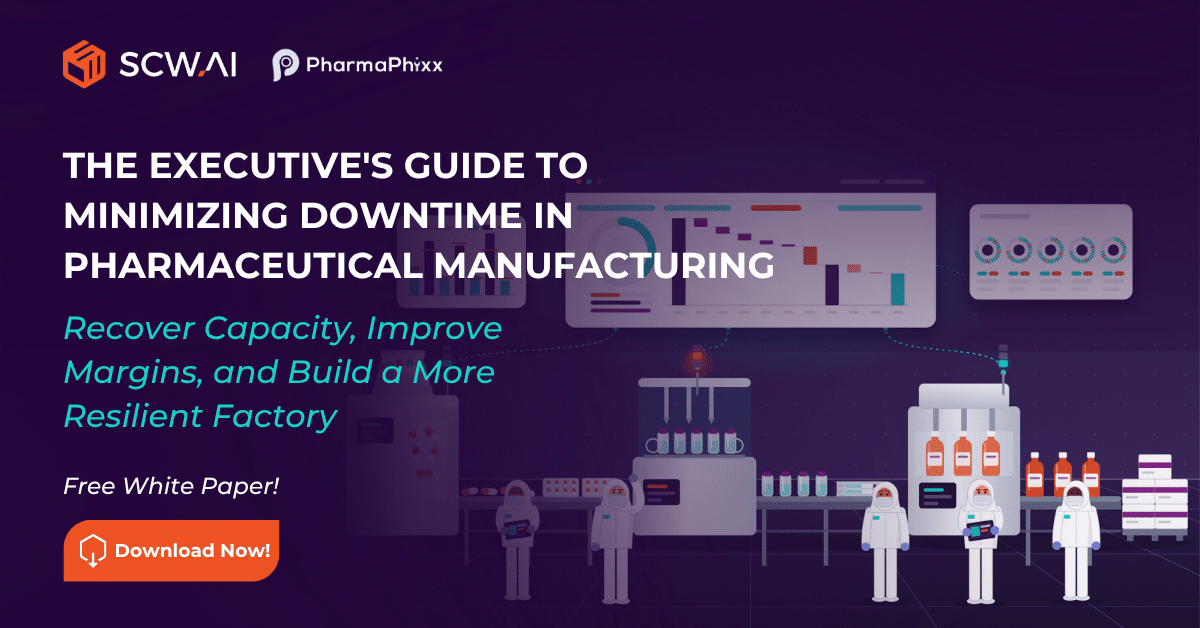
This article summarizes the key findings of The Executive’s Guide to Minimizing Downtime in Pharmaceutical Manufacturing, a white paper co-authored by SCW.AI and PharmaPhixx. The two partners will also present the findings in a free live webinar.
Key Takeaways
- A typical pharma plant loses about 50% of staffed time to downtime: ~30% planned, ~20% unplanned. Average OEE is ~37% and TEEP ~25%.
- Modernized digital-lean plants reach 55–60% OEE; top-quartile plants approach 70%.
- Machine failures are the largest single loss (~21% of staffed time), followed by paperwork (~10%), line cleaning (~8%) and setups (~8%).
- The hourly cost of industrial downtime roughly doubled between 2019 and 2023, and labor, energy and freight costs have kept rising since.
- In a modeled 10-line plant, downtime reduction alone recovers ~5,000 productive hours a year and adds 7–15 percentage points of gross margin.
- Technology shows where time is lost; engineers recover it; digital standards keep it recovered.
- Only about 5% of pharma plants are ready for large-scale AI. The data foundation comes first.
How Much Downtime does a Typical Pharmaceutical Plant Have?
A typical pharmaceutical plant loses about 50% of its staffed operating time to downtime: roughly 30% to planned activities such as cGMP paperwork, line cleaning, setups and tier meetings, and 20% to unplanned stoppages, mainly machine failures, according to SCW.AI benchmark analysis (2026). That is why average pharma OEE sits near 37% and Total Effective Equipment Performance (TEEP) near 25%.
Put differently, three-quarters of the industry’s built capacity is unproductive at any given moment. Performance losses (speed losses, micro-stops) and quality losses (rework, scrap) together account for only about 10% of staffed time. Availability is where the money is.

Two numbers deserve a second look. Machine-failure time falls by more than half, from 20.8% to 8.6% of staffed time. And “other” losses rise, from 2.5% to 6.8%. That is not a regression. Modernized plants deliberately invest more time in data-driven planned maintenance so they lose far less to breakdowns. Planned downtime done well is the price of avoiding unplanned downtime.
Why is Downtime in Pharma Manufacturing Getting More Expensive?
Because nearly everything that keeps burning while a line stands still now costs more. Siemens estimated in 2024 that the hourly cost of industrial downtime roughly doubled between 2019 and 2023. In pharma, labor, energy, API, freight and cGMP compliance costs compound the effect: a stopped cleanroom still draws HVAC, wages and validation overhead.
Run a simple thought experiment. If an hour of your plant’s time costs twice what it did in 2019, then a chronic 20-minute changeover overrun is no longer a shop-floor annoyance. It is a P&L line the CFO should see.

How does Downtime Hit Pharma KPIs and Margins?
Downtime cuts availability, the largest and most leveraged term in OEE (Availability × Performance × Quality), and the damage cascades. Process hold times come under threat, schedule adherence slips, On-Time In-Full (OTIF) delivery erodes, fixed overhead spreads over fewer units, and capacity-constrained plants lose revenue they cannot recover later.
Missed deliveries can trigger contractual penalties and contribute to drug shortages, which is why reliability is now a commercial asset, not only an operational one.

What a Typical Plant Stands to Gain: The White Paper’s ROI Model
We modeled a 10-line plant with 100 operators, $30M in annual revenue (USD, 2026) and a 40% gross margin. Reducing downtime alone, with performance and quality held constant, recovers about 5,000 productive hours per year and lifts OEE from 36.2% to 52.8% (+16.6 percentage points).
- Capacity-constrained plants: revenue grows from $30.0M to about $43.7M with no new lines or floor space.
- Market-constrained plants (generics, CDMOs on fixed volumes): annual cost savings of about $2.5M.
- Either way: gross margin rises by 7 to 15 percentage points.
The full assumptions, formulas and both scenarios are in the white paper, so you can rerun them with your own numbers.
Can Industry 4.0 and Lean Manufacturing Reduce Downtime in a Pharmaceutical Plant?
Yes, when digital visibility is paired with lean execution. Real-time data from machines, operators and quality records shows where and why time is lost. Experienced engineers fix the root cause. Digital standards keep the fix in place. Audited World Economic Forum (WEF) Lighthouse pharma sites have cut unplanned downtime by 31% to 50% this way.
You cannot improve what you do not measure in real time. Most plants still reconstruct downtime from paper logs, spreadsheets and end-of-shift reports. Those are lagging indicators: they explain yesterday’s stoppage but cannot prevent today’s. The white paper frames sustained downtime reduction as a scientific cycle:
- Capture timely, accurate, complete and granular data, down to the workstation. A line rarely fails all at once; it stops at its weakest asset.
- Analyze root causes: separate chronic losses from one-off events and rank them by financial impact.
- Act and standardize: fix, verify the result against the baseline, then roll the proven practice out to other lines and sites.
Without good data, plants act on assumptions. A packaging machine looks unreliable when the real cause is upstream material variability. A night shift underperforms because of the schedule, not the crew. “Operator error” turns out to be an ambiguous SOP.
Software, however, does not replace a worn part. In her foreword, Andrea N. Wagner, CEO of PharmaPhixx, recalls lines that stayed down for more than a week because a single component failed and no one on site had seen that failure before. The repair took hours; finding the right expert took days. In sterile manufacturing, those days mean expired hold times, batches at risk and schedules that ripple for months. Data points to the problem. People solve it.

What are the Best Practices to Minimize Downtime in Pharmaceutical Manufacturing?
Leading manufacturers follow a sequence:
- Build an automated data foundation
- Harmonize KPIs
- Make operations labor-aware
- Run data-driven maintenance
- Digitize quality documentation
- Schedule to minimize changeovers,
- Embed digital lean boards
- Bring in dedicated engineering support.
Each step depends on the one before it, which is why jumping straight to AI rarely pays.

Two data points show the scale of the prize. McKinsey has reported that documentation can consume up to 30% of time in some pharma operations, and SCW.AI case studies show paperless quality cutting data-entry time by 50% to 85%, worth more than 5% of OEE for many plants. Boston Consulting Group (BCG) estimates that changeover-aware scheduling software can save up to 30 minutes of changeover time per day. Daily routines such as a digital SQCDP board then make sure the gains stick.

What Results have Pharma Lighthouse Plants Achieved?
Independently audited WEF Lighthouse sites show that the jump from 37% toward 60%+ OEE is not theoretical. Cipla, Johnson & Johnson and AstraZeneca each reported double-digit gains in downtime or OEE at pharmaceutical sites by combining real-time data, analytics, predictive maintenance and AI scheduling, without building new plants.

Is Your Pharma Plant Ready for AI to Reduce Downtime?
Probably not yet, and that is normal. SCW.AI estimates that only about 5% of pharma plants are ready for large-scale AI; the rest need an automated data foundation and harmonized KPIs first. The prize is real: PwC projects AI could lift average pharma operating margins from 20.0% to 27.8% by 2030, largely through downtime reduction.
The high-impact use cases (predictive maintenance, AI scheduling, anomaly detection, automated task assignment) all learn your plant from your data. If downtime is logged by hand at the end of a shift, a model learns the handwriting, not the process. The harder part is human: BCG research finds that about 70% of AI value depends on people, culture and processes (2026). In GMP operations, the white paper recommends human-in-the-loop governance: AI recommends, qualified people approve, and validation, data integrity and explainability come first. For the full roadmap, see our AI in pharma manufacturing guide.
What’s Inside the Full White Paper?
This page covers the headline findings. The 70-page white paper gives you the models and playbooks behind them:
- A cost-of-downtime analysis across labor, materials, energy, freight and compliance, with FRED and IMF data
- The full ROI model: assumptions, formulas, and capacity- vs. market-constrained scenarios to rerun with your own data
- All eight best practices in depth, with KPIs, product-agnostic examples and pitfalls
- An AI readiness assessment, four high-impact AI use cases and change-management guidance
- Detailed WEF Lighthouse case studies from Cipla, Johnson & Johnson and AstraZeneca
- A downtime glossary and formulas, including lost-revenue, incurred-cost and recovery-cost methods
- Questions to Ask Your Team for every key finding, with lenses for finance, operations, IT and quality leaders
Join the Executive Webinar on Pharma Downtime Reduction
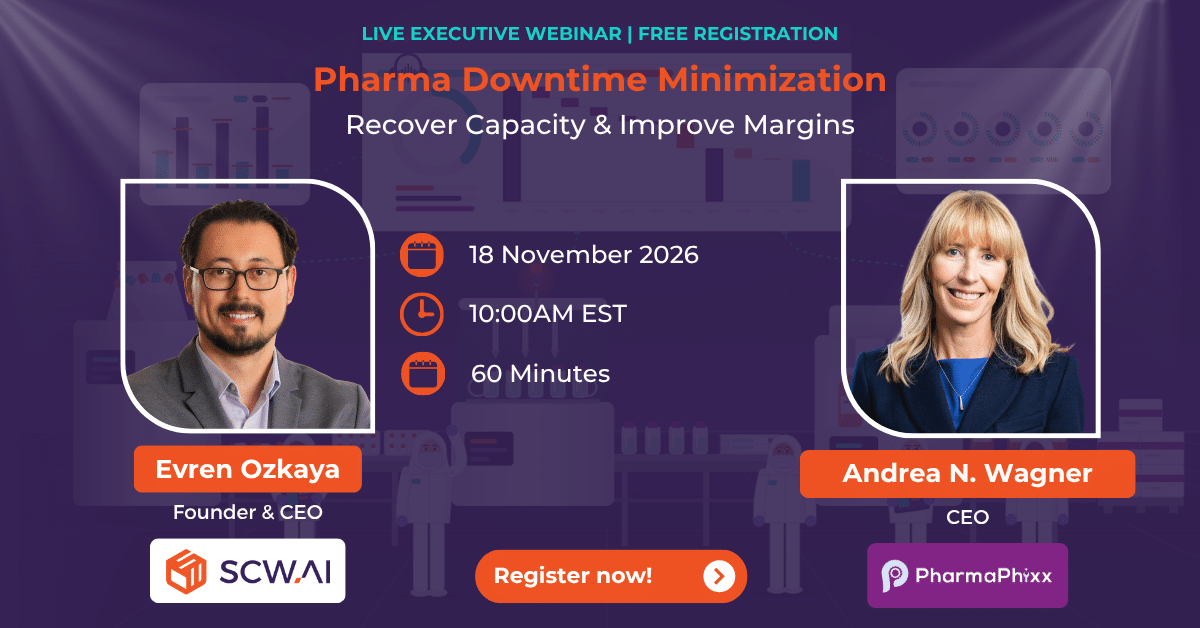
The white paper is the starting point; the webinar is where you can test it against your own plant. In a live session, Evren Ozkaya, Ph.D., Founder and CEO of SCW.AI and Andrea N. Wagner, CEO of PharmaPhixx will walk through the findings and take your questions.
Date and time: November 18th, 2026. · 10:00 AM EST | 60 Min. · Online, free.
You will leave with:
- How to measure your plant’s downtime in a reliable and automated way.
- How the ROI model plays out for capacity-constrained vs. market-constrained plants.
- A clear pharma downtime minimization roadmap supported via success studies and real world applications of industry 4.0 solutions.
- Live Q&A on your own downtime questions
Curious what your own downtime waterfall looks like? Talk to our team for a no-pressure walkthrough.
Get Your Free White Paper Now!
Fill out the form below to receive The Executive’s Guide to Minimizing Downtime in Pharmaceutical Manufacturing White Paper and reserve your seat at the live webinar. Both are free.
Frequently Asked Questions
What is downtime in pharmaceutical manufacturing?
Downtime is any part of staffed time when a line is not producing. Planned downtime covers required activities such as setups, line cleaning, cGMP documentation, planned maintenance and tier meetings; it can be optimized but not eliminated. Unplanned downtime covers unexpected stops such as machine failures, material shortages and power or IT issues; the goal is elimination.
How much downtime is normal in a pharma plant?
A typical pharmaceutical plant loses about 50% of staffed time to downtime: ~30% planned and ~20% unplanned (SCW.AI benchmark analysis, 2026). Modernized plants keep total downtime around 30–35%, and top-quartile plants below 30%.
What causes the most downtime in pharma plants?
Machine failures are the largest single loss at roughly 21% of staffed time, followed by paperwork and documentation (~10%), line cleaning (~8%), setups (~8%) and tier meetings (~5%), based on SCW.AI OEE waterfall analysis (2026).
How much does an hour of downtime cost a pharma plant?
It depends on whether the plant is capacity- or market-constrained. A complete figure adds lost revenue (if demand exists) to incurred costs (idle labor, energy, maintenance, scrapped material) and recovery costs (overtime, OTIF penalties, expedited freight). Siemens estimated industrial downtime costs per hour roughly doubled from 2019 to 2023. The white paper includes all three calculation methods.
Can Industry 4.0 really minimize downtime in a pharma factory?
Yes, when real-time data is combined with lean execution. WEF Lighthouse pharma sites have reported unplanned downtime reductions of 31% to 50% and OEE gains of 31 to 37 percentage points. Data alone will not fix a failing component; it tells skilled people where to act first.
Should we start with AI or with a data foundation?
Start with the data foundation. AI models for predictive maintenance or job shop scheduling need automated, granular and consistently defined data. SCW.AI estimates only about 5% of pharma plants are ready for large-scale AI today, so most plants gain more from automated data capture and harmonized KPIs first.
Does reducing downtime create cGMP compliance risk?
Downtime reduction targets non-value-adding time, not validated controls. Changes to cleaning, setup or documentation procedures still go through your normal change control and validation. Digital records with audit trails can also support data-integrity expectations, but compliance always depends on how each system is validated and used. In addition, minimizing downtime is often associated with higher first pass yield and setting quality by design processes. They positively impact the quality of your production and reduce cGMP compliance risk.
In addition, the main source of lost productivity in most pharmaceutical manufacturing plants is unplanned downtime caused by equipment failure, where reduction of it is unrelated to cGMP compliance.