
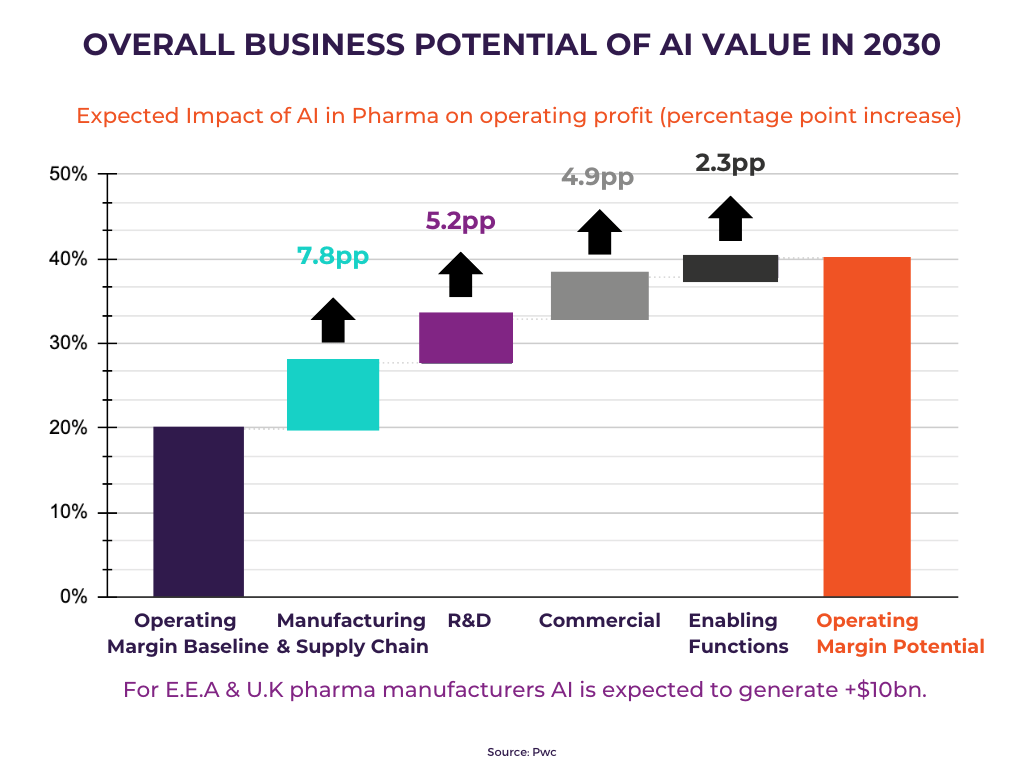
Artificial Intelligence is quickly becoming one of the largest value-creation opportunities in pharmaceutical manufacturing. According to research by PwC, AI applications could unlock over $100 billion in value across manufacturing operations while elevating average pharmaceutical profit margins from 20.0% to 27.8% by 2030.
Yet, despite widespread industry excitement, the majority of pharmaceutical manufacturers are not ready to deploy AI successfully.
AI cannot optimize processes, predict failures, or streamline schedules without reliable real-time data, harmonized manufacturing analytics, and digital execution systems. For most pharmaceutical manufacturers, the primary challenge is not selecting an AI algorithm. It is building the digital foundation required to make AI trustworthy, compliant, and actionable.

This guide summarizes the key findings from our free eBook, “A Complete Handbook on AI in Pharma Manufacturing: Potential, Applications, Readiness, and Best Practices to Outperform the Competition“, covering AI readiness, digital maturity, practical use cases, regulatory expectations, and implementation best practices for pharmaceutical manufacturers.
Why AI is Becoming a Strategic Priority for Pharmaceutical Manufacturers
AI is not simply another incremental software investment that improves key business metrics by 3% to 5% annually. When supported by strong digital foundations, AI becomes a transformational capability; enhancing productivity, quality, agility, and sustainability across the plant floor simultaneously.
Verifiable data from World Economic Forum (WEF) Lighthouse factories demonstrates the magnitude of this impact:
- OEE improvements of up to 37 percentage points
- Operating cost reductions of up to 26%
- Productivity improvements approaching 80%
- Quality deviation reductions of up to 52%
- Rework reductions of up to 99%
- Changeover reductions of more than 20%
- Energy consumption reductions exceeding 30%


Crossing the "Super Gap"
These outcomes illustrate a critical strategic reality: combining advanced AI with a mature digital infrastructure creates a “Super Gap” separating digitally transformed pharmaceutical leaders from traditional competitors. Crossing this gap enables pharma executives to solve long-standing strategic dilemmas:
- Expanding Capacity Without Capital Expenditure: Policy initiatives in the U.S. and Europe—such as trade tariffs and the EU Critical Medicines Act—are pressuring companies to expand domestic drug manufacturing. Achieving a 30-percentage-point increase in OEE effectively doubles plant throughput within an existing footprint, avoiding the massive capital expenditure and multi-year delays required for greenfield facility construction.
- Achieving Structural Cost Leadership: Modernizing operations through AI routinely reduces total operating costs by 20% or more, providing an objective buffer against global margin pressure.
- Elevating Quality to World-Class Standards: For contract manufacturers and global pharmaceutical brand owners alike, automated visual inspection, real-time anomaly detection, and paperless quality systems elevate First-Pass Yield to near-perfect levels, systematically de-risking operations against regulatory non-compliance.
- And more.
The Building Blocks of an AI-Ready Pharmaceutical Factory
Successful AI deployment begins long before machine learning algorithms are trained. The foundational work requires modernizing the plant floor itself.
AI cannot function in an informational vacuum. To move beyond isolated pilots and achieve true operational impact, an AI-ready pharmaceutical factory relies on essential capabilities:

Automated Data Collection
Modern pharmaceutical facilities capture high-resolution operational data automatically at the source. By deploying PLC integrations, OPC servers, Industrial IoT sensors, and connected shop-floor assets, factories eliminate manual transcription lag and human error, transforming production telemetry into real-time operational visibility.
Harmonized Manufacturing Analytics
Collecting data is only the first step—data must also speak a unified language. Facilities need enterprise-wide, standardized formulas for core Manufacturing KPIs, including:
- OEE
- First-Pass Yield
- On-Time, In-Full (OTIF) Delivery
- Schedule Adherence & Attainment
- Changeover & Setup Durations
- Detailed Downtime Categorization
- Labor Utilization & Productivity
- Maintenance Analytics and more
Without calculation harmonization across lines and manufacturing sites, AI models cannot establish reliable baselines, compare performance, or generate trustworthy optimization recommendations.
Paperless Quality Systems
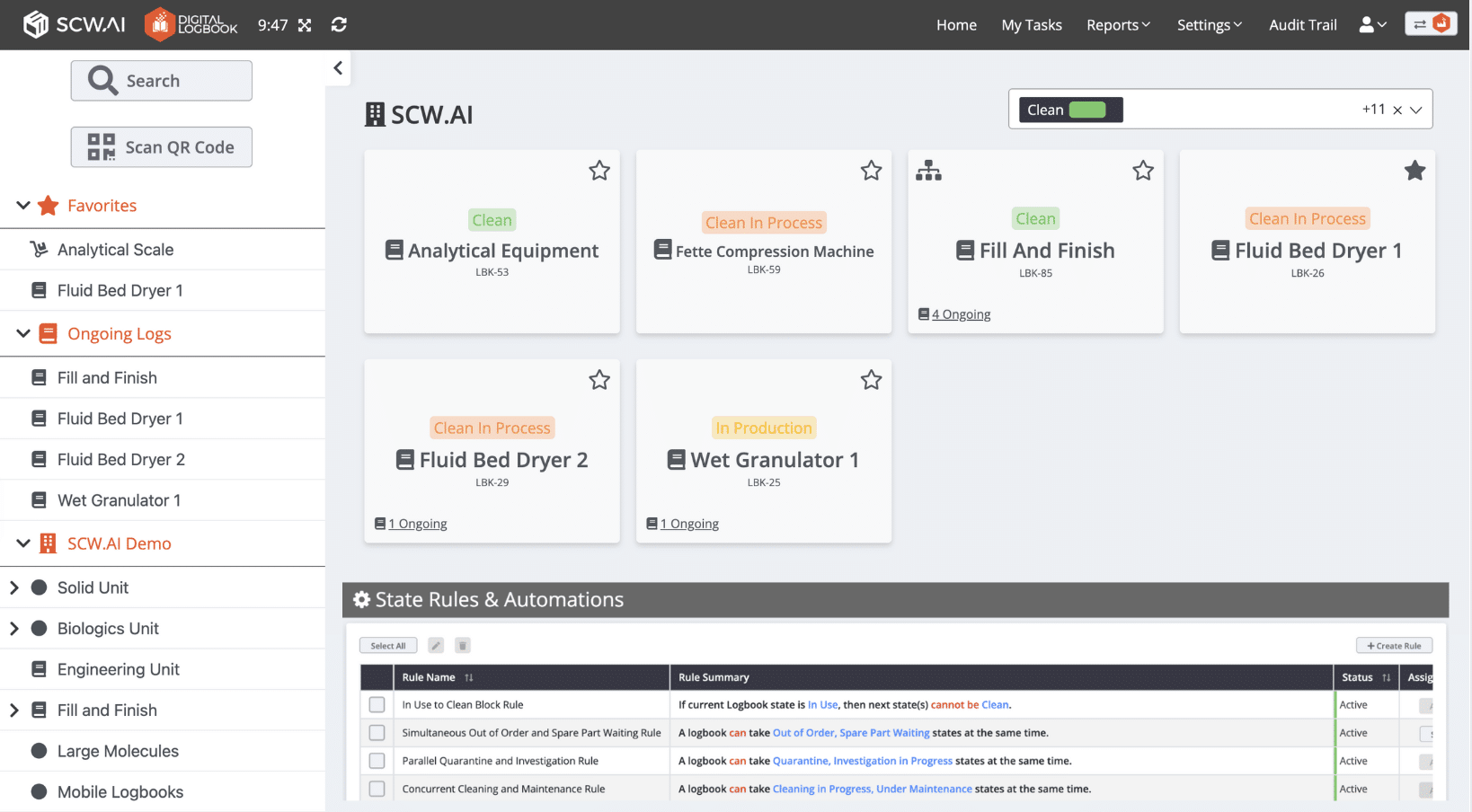
Transitioning to Digital Batch Records and Digital Logbooks connects GMP compliance directly with operational intelligence. Paperless quality solutions provide AI models with vital context—such as cross-referencing process parameters with deviation logs—while simultaneously hardening ALCOA+ data integrity and audit readiness.
Connected Factory Operations
Plant-floor functions (monitoring, planning, execution, compliance, maintenance, labor management, etc.) must operate as a single, unified digital ecosystem. Integrated platforms generate significantly richer, contextualized datasets than a fragmented collection of point solutions, providing the structural foundation required for enterprise AI models to thrive.
The Current State of AI Readiness in Pharmaceutical Manufacturing
Pharmaceutical manufacturing continues to lag behind other sectors in digital maturity. Multiple independent industry assessments highlight this execution gap:
- PwC estimates that roughly 90% of factories worldwide have completed less than half of their digital transformation roadmaps.
- Microsoft Healthcare strategy leadership indicates that only 1% to 3% of pharmaceutical organizations demonstrate “very high” digital maturity globally.
- Taken together, these benchmarks reveal a stark reality: only 5% of pharmaceutical factories worldwide currently possess the digital infrastructure required to support enterprise-scale AI deployment.
The Common Friction Points
Common challenges include:
- Limited machine connectivity
- Fragmented data sources
- Limited real-time visibility
- Inconsistent and retrospective KPI calculations
- Manual and paper-based log and batch records
- Disconnected and excel based production planning and maintenance
- Isolated and tacit organizational knowledge
Without addressing these foundational challenges, AI projects frequently struggle to produce reliable business value.
For more detailed analysis you can download our free handbook.
The Highest-Impact AI Use Cases in Pharmaceutical Manufacturing
Different AI applications solve different operational problems. Selecting the right use case depends entirely on the organization’s business priorities and digital maturity. Some of today’s highest-value manufacturing AI applications include:

Predictive Maintenance
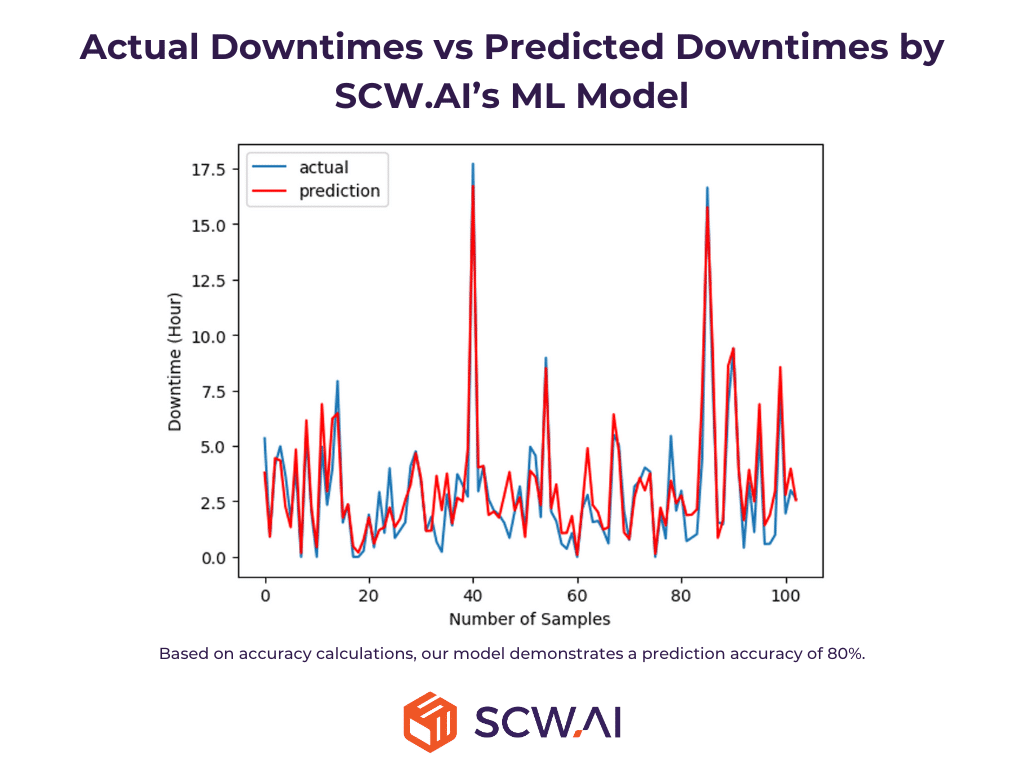
Machine learning predicts equipment failures before they occur by analyzing vibration, temperature, historical failures, maintenance history, production speeds, and machine utilization.
Benefits include:
- Reduced unplanned downtime
- Lower maintenance costs
- Improved OEE
- Higher production availability
AI Production Scheduling
Advanced optimization algorithms evaluate thousands of production scenarios within seconds.
Instead of manually balancing competing priorities, AI simultaneously considers:
- Changeover minimization
- OTIF performance
- Hard and soft constraints
- Labor availability
- GMP requirements
- Cleaning schedules
- Profitability
The result is more efficient production schedules aligned with business objectives.
Manufacturing Anomaly Detection
Rather than waiting for problems to become visible, AI continuously monitors manufacturing processes to identify abnormal patterns early. This enables manufacturers to intervene before deviations become costly failures.

Automated Action Assignment
AI can automatically assign shop-floor tasks to the most appropriate operator based on certifications, workload, location, historical performance, and current priorities.
This dramatically reduces response times while improving execution consistency across shifts.
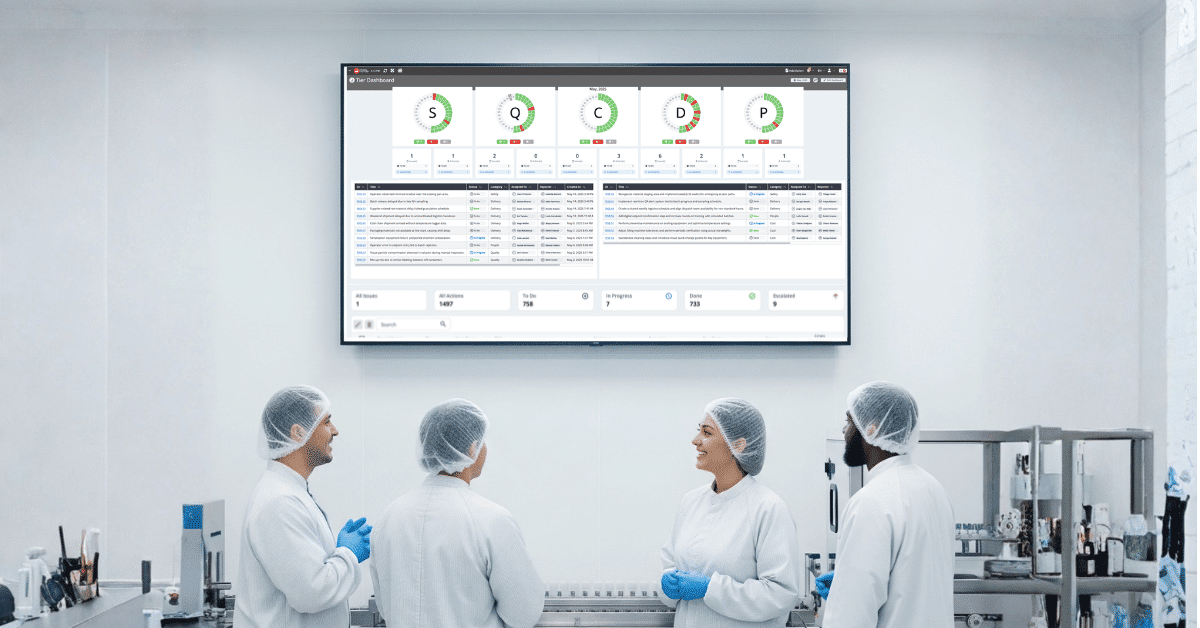
To explore all high-impact AI use cases for pharmaceutical factories—including those not covered here—alongside their required digital infrastructure, download the free handbook.
Regulation Is No Longer the Biggest Barrier
Many pharmaceutical executives still assume AI adoption is primarily constrained by regulation. Current regulatory developments suggest otherwise.
Both the FDA and EMA have actively published guidance addressing AI adoption within regulated pharmaceutical environments.
Rather than discouraging AI, regulators increasingly focus on ensuring that AI systems remain transparent, validated, and appropriately governed.
Current regulatory expectations generally emphasize four principles:
- Human-in-the-Loop oversight
- Model validation
- Data integrity
- Explainability
In other words, regulators expect AI to support human decision-making rather than replace qualified personnel.
Organizations that establish strong governance frameworks can adopt AI while remaining compliant with GMP requirements.

Technology Alone Does Not Deliver AI Success
Boston Consulting Group has observed that approximately 70% of the value generated by successful AI transformations comes from people-related actions rather than technology itself.
This means organizations must prepare for significant operational change. Successful manufacturers typically invest in:
- Executive sponsorship
- Digital Excellence teams
- Workforce upskilling
- Change management
- Data-driven decision making
- Cross-functional governance

Download the Complete AI in Pharmaceutical Manufacturing Handbook
This article provides a high-level overview of how pharmaceutical manufacturers can prepare for AI adoption.
Our free handbook, AI in Pharmaceutical Manufacturing explores these topics in much greater depth, including:
- The current state of AI adoption in pharmaceutical manufacturing
- AI readiness and digital maturity assessment
- Six high-impact AI use cases and their implementation prerequisites
- FDA and EMA perspectives on AI
- Best practices for successful AI deployment
- A practical roadmap for building an AI-ready pharmaceutical factory
If your organization is evaluating AI initiatives or planning its digital transformation strategy, the handbook provides a practical framework to help identify the right investments, avoid common implementation pitfalls, and prioritize initiatives that deliver measurable business value.
Get Your Free Handbook Now!
Fill out the form below to receive a free copy of the full report, “A Complete Handbook on AI in Pharma Manufacturing: Potential, Applications, Readiness, and Best Practices to Outperform the Competition“.